
Slant Bed vs. Flat Bed CNC Lathe: Complete ROI & Technical Selection Guide for Machine Shops
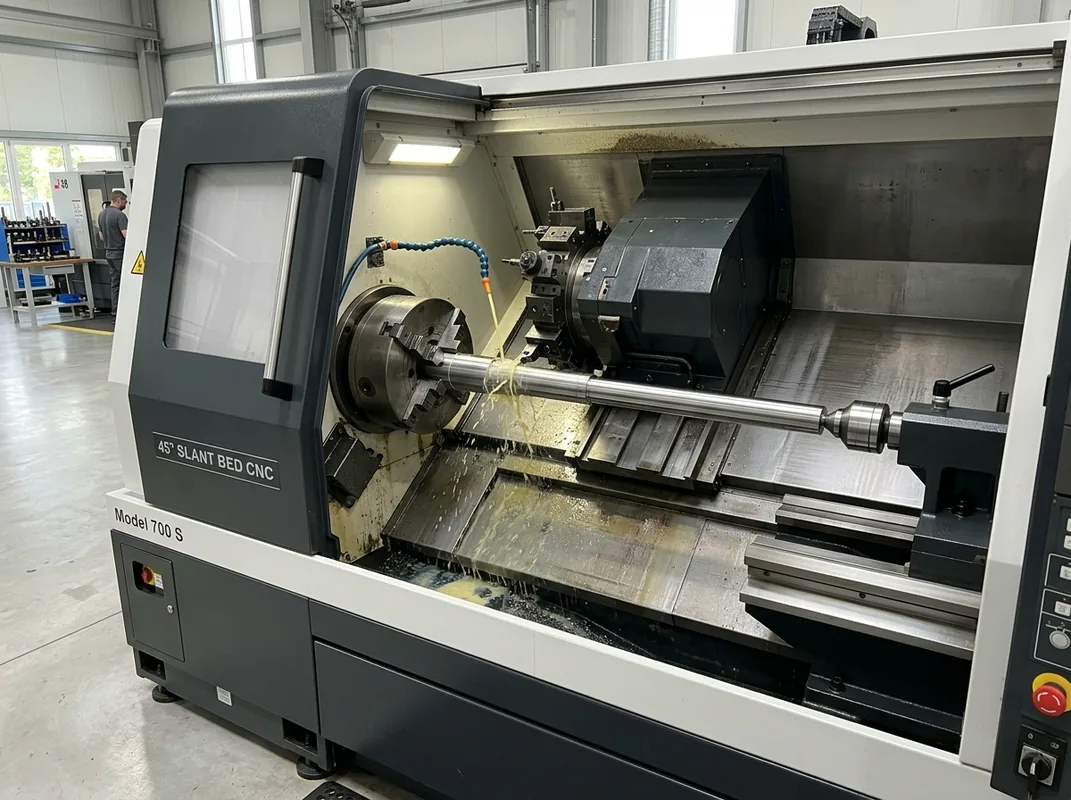
Executive Summary: The Structural Divide in CNC Turning
When equipping a precision turning cell, one of the primary capital investment decisions is choosing between a Slant Bed CNC Turning Center (such as the Dongs Solution TCK series) and an Industrial Flat Bed CNC Lathe (CK series). While both machine types share common CNC kinematic axes (X and Z), their physical architecture dictates fundamentally different performance thresholds in chip evacuation, thermal drift, tool change speed, and long-term dimensional repeatability.
1. Architectural Differences: Gravitational Physics & Thermal Stability
The defining distinction lies in the angle of the guideway plane relative to the workshop floor:
- Flat Bed Lathes (0° horizontal plane): The carriage travels on horizontal ways. As cutting chips are generated, they accumulate directly on the front bedways, cross-slide cover, and ballscrews. During heavy roughing, glowing hot chips transfer heat directly into the bed casting, creating thermal expansion and gradual dimensional drift along the X-axis.
- Slant Bed Turning Centers (30° or 45° inclined plane): The spindle, carriage, and linear guideways are positioned along a steep incline. Gravity works in your favor: chips, cutting coolant, and scale fall freely downward into the trough of the central chip conveyor without touching the linear guides.
Key Engineering Insight: On a 30° slant bed like the Dongs Solution TCK50, thermal growth along the workpiece diameter is reduced by up to 65% compared to a flat bed machine during 8 hours of continuous batch cutting.
2. Side-by-Side Technical Comparison Matrix
| Engineering Factor | Slant Bed CNC Lathe (TCK Series) | Flat Bed CNC Lathe (CK Series) |
|---|---|---|
| Bed Geometry | 30° or 45° Monolithic Slant Casting | Horizontal Flat Cast Bed |
| Tool Changer | 8/12-Station Fast Servo Turret (0.2s) | 4-Station Electric Toolpost (1.5-2.5s) |
| Rapid Traverse | 24 – 30 m/min | 8 – 10 m/min |
| Chip Evacuation | Gravitational, direct to automatic conveyor | Manual clearing or intermittent rake conveyor |
| Guideway Type | Heavy-duty Roller Linear Guides | Induction-Hardened Boxways (HRC 52+) |
| Ergonomics | Operator is closer to the spindle center | Higher reach over the front apron |
| Best Workpiece Profile | Batch shafts, bushings, flanges (< 400mm) | Long shafts (up to 3000mm), repair, pipes |
3. Production Economics & Cycle Time Math
To illustrate the return on investment (ROI), consider a high-volume automotive bushing component (AISI 4140, OD 65mm, Length 80mm, facing, OD turning, boring, and grooving):
- Flat Bed Lathe (CK6140):
- Cutting time: 72 seconds
- Tool change & positioning time: 18 seconds
- Chip clearing pause: 15 seconds per part
- Total cycle time: 105 seconds (approx. 27 parts/hour)
- Slant Bed Turning Center (TCK50):
- Cutting time: 54 seconds (due to 30% higher cutting speeds enabled by dynamic rigidity)
- Tool change & rapid positioning: 4 seconds
- Chip clearing pause: 0 seconds (continuous conveyor operation)
- Total cycle time: 58 seconds (approx. 62 parts/hour)
Outcome: The slant bed turning center delivers more than double the throughput per 8-hour shift, cutting per-part labor and electricity costs by over 40%.
4. When Does a Flat Bed Lathe Make Superior Financial Sense?
Despite the throughput advantages of slant bed machines, the Dongs Solution CK6150 and CK6160 flat bed lathes remain indispensable for specific workshop environments:
- Extra-Long Shaft Machining: When turning hydraulic rods, oilfield drill tubes, or ship drive shafts exceeding 1,000mm up to 3,000mm, a flat bed provides broad, stable support with steady rests at a fraction of the capital cost.
- Job-Shop & Toolroom Maintenance: When producing single prototypes, one-off spare parts, or manual repair threading, the simplicity and larger swing-over-bed of the CK series maximizes flexibility.
- Budget-Constrained Capital Allocation: Initial acquisition cost of a flat bed lathe is 30% to 50% lower than an automated slant bed turning center.
Summary Recommendation
- Choose the TCK Slant Bed Series if your monthly production volume exceeds 500 parts per batch, you process tough alloy materials requiring continuous high-pressure coolant, or you plan to integrate robotic bar feeders.
- Choose the CK Flat Bed Series if you require turning lengths over 1,500mm, handle diverse repair work, or want a heavy-duty, dependable general-purpose lathe for custom shafts and flanges.
Need an application engineer to evaluate your workpiece drawing and calculate exact cycle times? Contact Dongs Solution at xiuc32860@gmail.com for a free technical consultation.
Have a Workpiece Drawing or Sourcing Question?
Our senior application engineers can simulate your part cycle times on Dongs Solution VMC and TCK lathes, recommend optimal tooling packages, and provide competitive FOB/CIF quotations within 2 hours.